Machine Learning

Louis
How to optimize machine learning model performance with MLOps?

In this article, we explore the application of MLOps to optimize the performance of Machine Learning models and ensure their reliability in production.
In the world of Artificial Intelligence and Machine Learning, many organizations face the challenge of moving from a simple prototype to deploying a model in production. Industrializing a Machine Learning model presents several technical issues and challenges, such as evolving data, retraining, and automated model deployment. In this article, we will discuss how MLOps practices can be used to optimize the performance of Machine Learning models and ensure their reliability over time in a production environment.
Implementing an MLOps approach allows you to monitor and anticipate the degradation of Machine Learning model performance over time. Once a model has been trained and deployed, it is essential to track its performance to ensure it continues to produce accurate and reliable results. Without proper monitoring, a model's performance can degrade due to changes in input data, target data, or other external factors.
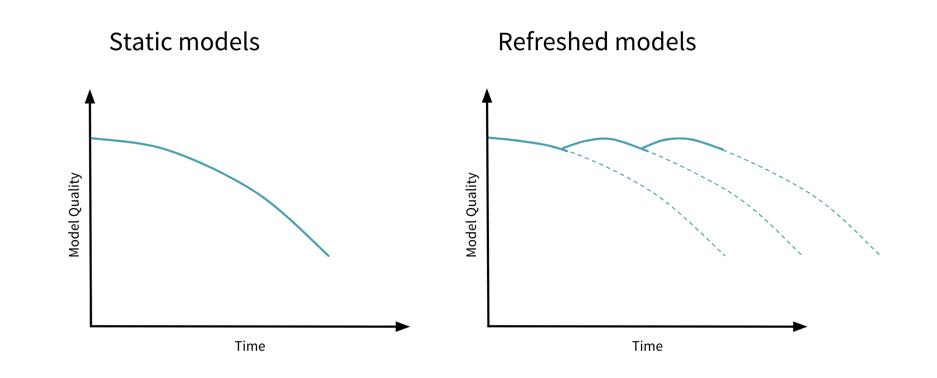
The answer to our problem lies in applying MLOps practices, particularly regarding model monitoring. There are various methods for monitoring model performance and detecting potential degradation:
Data quality: It is essential to monitor the quality of the data used for model training and inference. This includes checking data volume, column integrity, data type consistency, and more. Any deviation from expectations can be an indicator of a potential problem.
Outlier detection: To improve the reliability of our model and its predictions, we add an anomaly detection model designed to evaluate the input data for our prediction model. Sometimes, unusual data can appear that is very different from the training set, increasing the likelihood of an erroneous prediction.
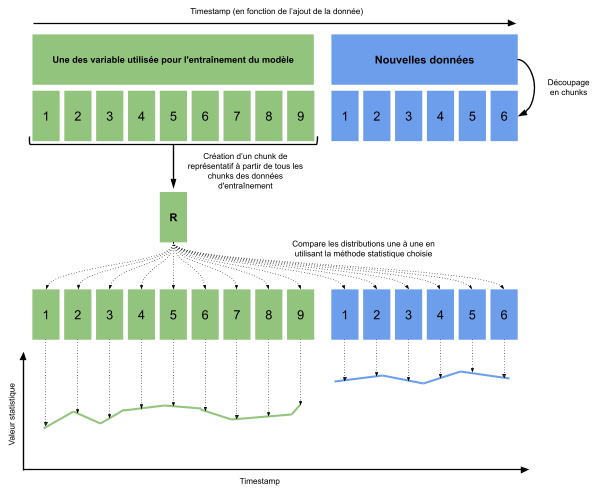
Data drift: Data drift occurs when new input data evolves or differs from the data on which the model was trained. It is important to detect this drift to prevent the degradation of model prediction performance. Statistical methods, such as Jensen-Shannon divergence and the Wasserstein metric, can be used to measure this data drift.
Concept drift : Concept drift occurs when the relationship between input data and target data (what you are trying to predict) changes. This can happen due to changes in the external environment or underlying processes. While there is no direct statistical method to assess concept drift, it can be monitored by comparing the drift of input data against the drift of target data.
Model performance evaluation: It is essential to collect data on model predictions and compare them to reality when it becomes available. This allows you to measure the model's accuracy and consistency under real-world conditions.
Estimating model performance: Estimating model performance without knowing the actual target data can be achieved using methods such as CBPE (Confidence-based Performance Estimation). This provides insight into the model's expected performance before actual data becomes available.
Interpretability: While this section does not directly monitor model performance, interpretability is a key topic in MLOps and can be useful for understanding the origin and impact of data or concept drift.
NannyML is an open-source Python library that makes it easy to monitor machine learning models. NannyML is designed to detect silent model failures: estimating model performance after deployment, detecting data drift, and monitoring performance once target data becomes available.
With this library, you can monitor data drift in a univariate manner—that is, monitoring drift in the distribution of each variable independently. Here is a schematic of how this drift is monitored:
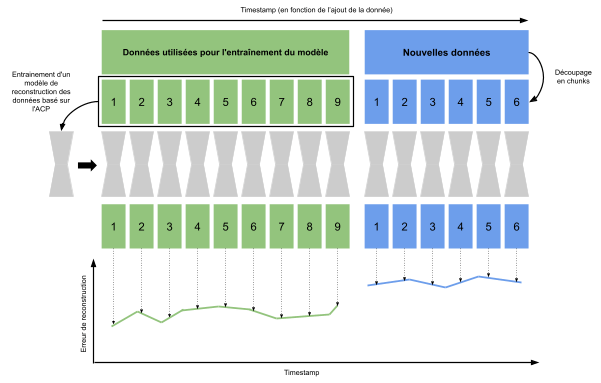
It is also possible to monitor data drift in a multivariate manner—that is, monitoring drift in the distribution of all variables simultaneously. Here is a schematic of how this drift is monitored:
In conclusion, MLOps practices play a vital role in optimizing machine learning model performance. Using tools like NannyML and implementing monitoring dashboards makes it possible to track model performance continuously and in real time, anticipate degradation, and detect data drift. This ensures the reliability and relevance of model predictions in a production environment. Although implementing these techniques requires technical expertise and close coordination with business experts, the benefits in terms of the quality of future model deployments make investing in MLOps practices assuredly worth it.
Lorem ipsum dolor sit amet consectetur. Ipsum penatibus viverra feugiat amet varius pharetra porta risus lectus. Turpis enim massa non tincidunt in faucibus.