Can you chat with your company database just like you do with ChatGPT?

What if querying your database were as simple as asking ChatGPT a question? Accessing and analyzing data are essential to the success of any business. However, effective data utilization is often hindered by the need for specialized technical skills, particularly in SQL or BI, and a deep understanding of the company's data schema. This technical barrier limits access to information for a vast majority of employees, creating a bottleneck in certain decision-making processes.
There is growing interest in accessible and simple AI interfaces. We can imagine a world where corporate databases are not only accessible to a limited fraction of employees but to everyone via a simple conversational experience like with ChatGPT.

This use case aims to address two main objectives:
These objectives are accompanied by an essential priority: ensuring secure and reliable database operation, thereby guaranteeing the protection of sensitive information.
The BIRD benchmark, published in 2023, focuses on evaluating AI performance on text-to-SQL tasks. This refers to an AI model's ability to translate a question formulated in natural language into a reliable and correct SQL query, allowing for digital interaction with a database.
The BIRD database centralizes 95 other databases (33.4 GB) from 37 different professional domains (represented below). It contains 12,751 question-answer pairs: each question formulated in natural language is provided with its associated answer expressed in SQL.
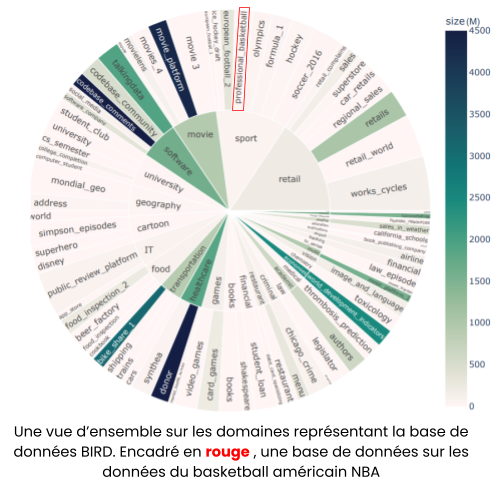
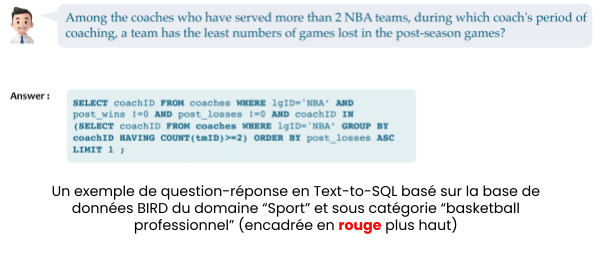
The BIRD benchmark stands out for its relevance, as it reflects a level of complexity and data quality close to that encountered in a real business. Thus, it offers a realistic framework for evaluating performance. For reference, human performance on this benchmark, achieved by data engineers, is 92.9%.
Below is the AI performance on this benchmark at the time of writing:
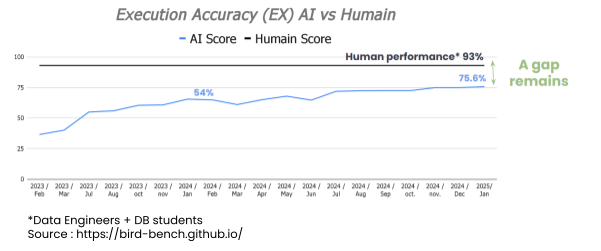
Since 2023, a real race has been underway to match human performance, but despite spectacular advances in the field of LLMs, AI researchers have not yet managed to reach this level.
If you would like to discover the technical approach adopted by one of the winning teams, you will find more details in the references cited in this article.
Driven by a desire to explore this innovative use case, a team from the Aqsone Lab conducted a series of experiments. Their goal: to evaluate the feasibility of conversational data exploration by leveraging existing solutions and approaches, without, however, participating directly in the BIRD benchmark.
Here are the key steps of our approach:
We reviewed existing solutions, ranging from off-the-shelf tools like DataGPT and DataChat to technical approaches such as natural language to SQL (text-to-SQL) or natural language to Python code generation.
The qualitative evaluation was based on a series of criteria, including functionality, cost, data privacy, compatibility with multi-table databases, ease of use, the ability to generate data visualizations, and the overall conversational experience.
Our analysis highlighted major limitations of certain existing tools, particularly in terms of transparency regarding their operation (and pricing), the quality of their documentation, guarantees regarding data privacy and security, and their ability to handle multi-table databases.
To best reflect real-world enterprise data, we generated an SAP procurement database. This dataset, designed to be accessible and understandable by a standard buyer, was used as the foundation for our experiments.
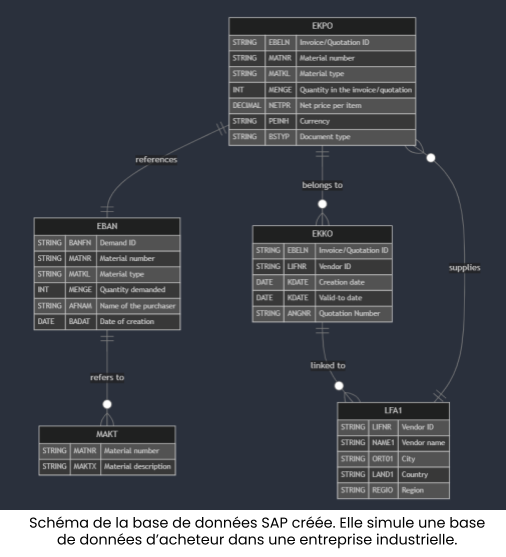
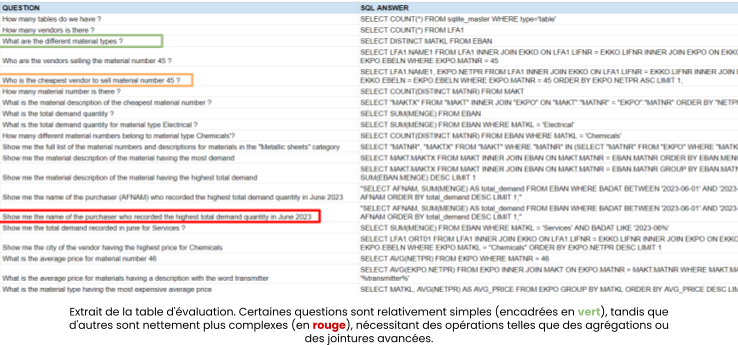
An evaluation dataset was also created. It consists of 30 question-and-answer pairs: a question formulated in natural language and an answer in SQL.
We implemented and tested three different approaches based on LLMs and existing frameworks, such as PandasAI, LangChain, LlamaIndex, and Vanna AI: these tools have the advantage of being pre-configured to address our use case. Consequently, they require very little customization.
The "Execution Accuracy" score is calculated based on the initially created evaluation dataset. This score allows for comparing the execution results of the ground truth SQL query and the predicted SQL query against the database content. Here are the results obtained:

In conclusion, using a more recent language model (GPT-4) combined with an agent-based approach using metadata and few-shot prompting, or a native LangChain chain approach, yields the best results on our dataset of 30 question-answer pairs.
To facilitate interaction with the LLM and the database, we designed a dedicated user interface based on Streamlit.

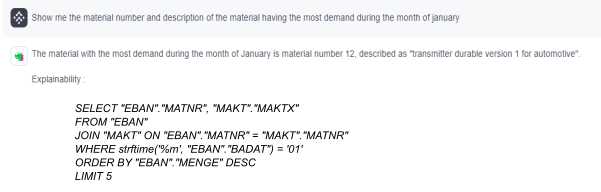
We integrated a feature that allows users to view the SQL query used to answer a question. Here is an example:
Our experiments have demonstrated the promising potential of LLMs for facilitating data access within companies. Chain-based and agent-based approaches stood out for their performance, achieving 70% execution accuracy on our experimental dataset. With the use of GPT-4, these approaches demonstrated an impressive native knowledge of SAP data and can offer a satisfactory level of explainability by displaying the generated SQL queries.
These results lead us to believe that AI could soon surpass data analysis experts in terms of speed and efficiency, specifically in the Text-to-SQL domain. The existence of the BIRD benchmark, dedicated to evaluating AI performance on text-to-SQL tasks, is a major asset for tracking progress and establishing performance standards for this use case.
Despite these promising advances, here are the three main challenges that remain:
To address this, here are some possible solutions:
Interacting with the tool should be as intuitive as using ChatGPT. Here are the best practices:
It is crucial to guarantee secure interactions, especially in an era where data—often sensitive—plays a central role in decision-making. The use of external APIs, such as OpenAI's, raises legitimate concerns regarding data security and privacy. It is therefore essential to implement robust solutions to protect this sensitive information:
Using LLMs for conversational data exploration is a major innovation that could transform how companies use and leverage their data. The progress made to date is encouraging and paves the way for an exciting future.
Lorem ipsum dolor sit amet consectetur. Ipsum penatibus viverra feugiat amet varius pharetra porta risus lectus. Turpis enim massa non tincidunt in faucibus.