DVC: The key tool for ML data management

Version control makes it easier for developers to work independently on a project. DVC (Data Version Control) extends this concept to data by enabling efficient management. This article explores DVC, defining its role in data science and explaining how to use it.
When developing data science and machine learning projects, it is essential to have tools that can manage data versioning. Data versioning allows you to track changes made to datasets, save different versions, and collaborate effectively with other team members. This ensures the reproducibility of experiments, facilitates the comparison of results, and allows you to revert to previous versions if necessary.
In this section, we will provide an overview of some of the leading data version control tools, highlighting their specific features and approaches. These tools include:
DVC is an open-source tool designed specifically for data versioning. It offers a simple, lightweight approach to managing data versions with seamless integration into Git. DVC stands out for its ability to maintain data flexibility and portability.

Git LFS is a Git extension that allows you to manage and version large data files. It is commonly used in software development projects to track binary files, but it can also be used for data versioning. However, Git LFS may have limitations regarding performance and the management of very large files.

Pachyderm is an open-source platform that combines data versioning with data processing pipelines. It allows you to manage large datasets and track changes made to the data. Pachyderm offers advanced features such as pipeline reproducibility and data version management, though it may have a steeper learning curve and require more complex configuration.

MLflow is an open-source platform developed by Databricks for managing the machine learning model lifecycle. While its primary function is model tracking and deployment, MLflow also includes data versioning features. However, it is more focused on experiment and model management than on specific data versioning.

Neptune.ai is a collaborative platform for data science projects. It offers features for experiment tracking, code and data versioning, and team collaboration. Neptune.ai focuses on experiment visualization and metadata management, providing a comprehensive view of the model development process.

You now have an overview of the most commonly used data version control tools in data science and machine learning projects. Each of these tools offers its own features and approaches to meet specific data management and collaboration needs.
In the rest of this article, we will focus on DVC in more detail. We will explore its advanced features, its integration with Git, and its specific benefits for data versioning in data science and machine learning projects. You will discover how DVC can improve the management of your datasets, simplify team collaboration, and help you maintain rigorous traceability of changes made to your data.
DVC is an open-source Python library that provides advanced features for data versioning in data science and machine learning projects. DVC can be easily installed using common tools like conda or pip, making it accessible to a wide range of users.
One of DVC's unique features is its free, open-source extension for the Visual Studio Code (VS Code) editor. This extension provides a dashboard that allows you to visualize different versions of data, models, and machine learning experiments. This feature makes it easy to navigate and understand version history, as well as compare results obtained at different stages of the project.
By using DVC, data scientists and developers can easily manage datasets, models, and configurations while maintaining experiment reproducibility and result traceability. DVC integrates seamlessly with version control tools like Git, which facilitates collaboration among team members and makes it easy to share datasets and trained models.
In summary, DVC is a powerful Python library, accompanied by a VS Code extension, that offers advanced features for data versioning in data science and machine learning projects.
DVC was designed to meet several essential objectives in data versioning, fostering effective collaboration in data science and machine learning projects. The main objectives of DVC are as follows:
DVC is specifically designed to handle large files, such as datasets and machine learning models, as well as their associated metrics. It stores this data in a secure, distributed repository, ensuring its integrity and availability for users. As a result, users can work with confidence, knowing that their data is protected and easily accessible for their analysis and collaboration needs.
When it comes to development projects, versioning code has become standard practice—and even essential—to reap the clear benefits it brings to the software community. Tracking every code change allows developers to navigate through time, compare previous versions, and resolve issues while minimizing disruption to the team. After all, code is a valuable asset that must be protected at all costs!
The same principle applies to data. Here are four reasons why you should use a version control tool for your data:
Machine learning models are typically developed by combining code, data, and configuration files, which can make reproducing results complex. DVC solves this by versioning data and tracking dependencies, making it possible to reproduce the same results on different machines or at different times.
DVC facilitates collaboration within teams working on machine learning projects. By versioning data, it becomes easier to share work and ensure that all members are working with the same inputs and outputs. It also simplifies the review of changes and makes it easy to track contributors.
DVC helps you track experiments and the results they produce. By versioning data, you can easily see which experiments were conducted with which versions of the code and data, as well as the results obtained. This makes it easier to iterate on models and improve performance over time.
As your machine learning projects grow, managing data and code becomes increasingly difficult. DVC solves this by versioning data, which makes it easier to manage and scale the project as it expands. Furthermore, it optimizes storage efficiency by saving only the changes made to the data rather than the entire dataset.
By adopting DVC, you will benefit from these advantages, which will improve the reproducibility, collaboration, experiment tracking, and scalability of your machine learning projects.

Using DVC involves several key steps for versioning and managing data. Here is how DVC works:
To get started, you can create a .dvc file using the command dvc add file. This file specifies the path to the directory containing the current version of the data. Next, you can use DVC to create a remote storage space. This can be a location in the cloud (AWS, GCP, Azure, Palantir Foundry, etc.) or a separate server/directory from your project. You can create this remote storage using the dvc remote add command directly from the terminal. Finally, you can push this version of the data to the remote storage using the dvc push command. This ensures the security and recoverability of the original data.
When you modify the original data file, DVC automatically updates the .dvc file to have a new path pointing to the modified data. You can update this file using the same dvc add file command. By using Git, you can track changes to this .dvc file and retrieve any desired data version using different Git commit messages.
By using the dvc push command, you can store different versions of your data in remote storage. This allows you to maintain a complete history of previous data versions in that space. As a result, you have the ability to retrieve any specific version of data that exists in the remote storage. This feature offers great flexibility and allows you to revert to previous versions of data if necessary, which can be particularly useful when exploring models or comparing performance between different data versions. By using DVC, you have the peace of mind of knowing that your data is secure, accessible, and reproducible at any time.
An important point to note is that the data files themselves are never tracked by Git. In projects using DVC, only files with the .dvc extension are tracked by Git. This allows for efficient management of large data files while maintaining version control with Git.
By using these steps, DVC makes it possible to track data version history, store it securely, and retrieve it easily, all while working in harmony with Git to track changes to .dvc files. This simplifies data management in data science and machine learning projects.
MLOps is a methodology that aims to facilitate the production and efficient maintenance of machine learning (ML) models. It involves a combination of practices, tools, and processes designed to automate and standardize ML workflows while ensuring the reproducibility, collaboration, and scalability of ML projects.
The importance of a data version control tool in MLOps is critical. ML models depend not only on code but also on the data used to train, validate, and deploy them. A data version control tool like DVC allows you to version and track data, ensure experiment reproducibility, facilitate team collaboration, automate data pipelines, and effectively manage ML model dependencies. This enables MLOps teams to maintain rigorous control over data and ensure consistent results, while also simplifying troubleshooting and model deployment to production.
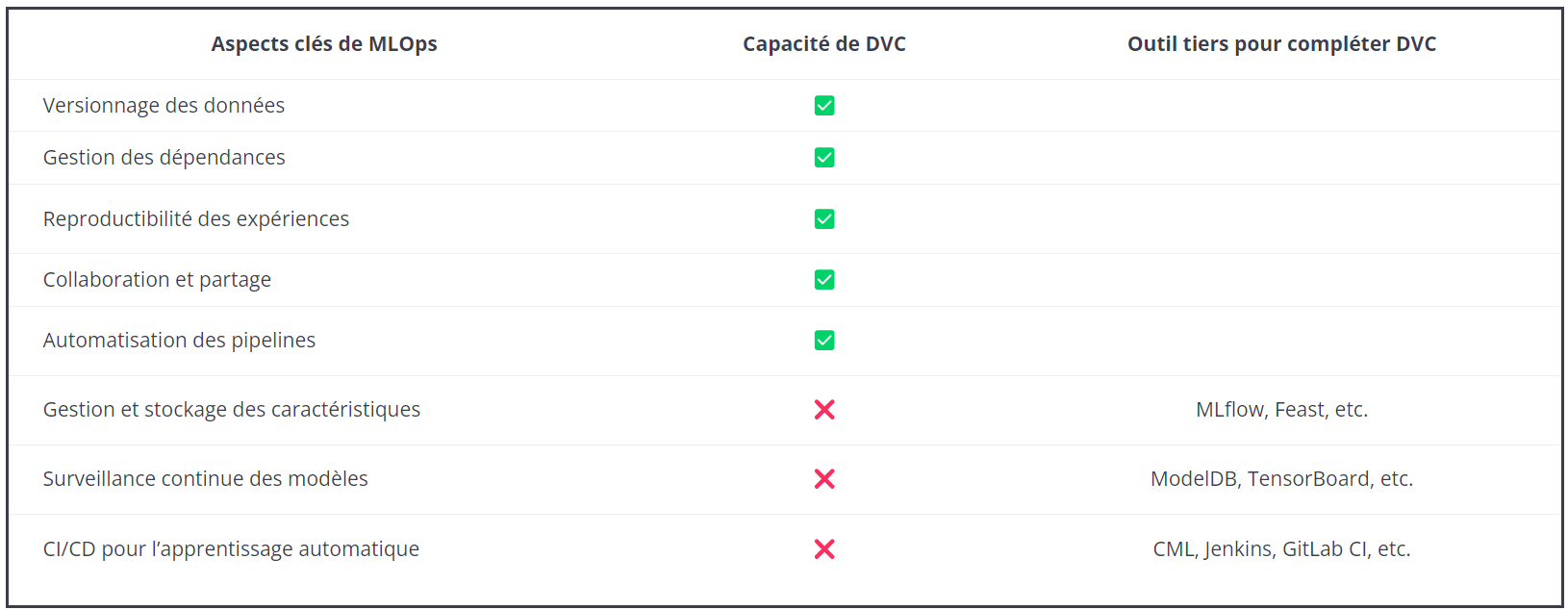
A data version control tool like DVC plays an essential role in implementing MLOps by enabling rigorous data management, experiment reproducibility, team collaboration, and pipeline automation. While it does not address every aspect of MLOps, DVC can be complemented by other specialized tools to meet specific needs for feature management, model monitoring, and CI/CD. By using DVC and other tools synergistically, MLOps teams can improve the efficiency, quality, and reliability of their ML projects.
DVC offers several key advantages in the MLOps field. It allows you to version data, track changes, restore previous versions when needed, and facilitate collaboration by providing a consistent way to manage model inputs and outputs. Furthermore, DVC integrates easily with other MLOps tools such as MLflow, allowing for more comprehensive management of the model lifecycle.
In conclusion, using a data version control tool like DVC is crucial in an MLOps environment. It ensures experiment reproducibility, facilitates team collaboration, enables efficient data management, and contributes to process automation. By integrating DVC into your MLOps workflow, you can improve the efficiency, traceability, and reliability of your data science projects.
Lorem ipsum dolor sit amet consectetur. Ipsum penatibus viverra feugiat amet varius pharetra porta risus lectus. Turpis enim massa non tincidunt in faucibus.