No items found.

Houcem
Palantir Foundry, a solution serving Data

Palantir Foundry, a data integration platform favored by the CIA, Ferrari, Airbus, and Sanofi, offers centralized storage, ease of use, versatility, and digital innovation potential. Aqsone, specializing in Foundry, supports clients in their transformation and data science projects.
What do the CIA, Scuderia Ferrari F1, Airbus, Sanofi, Fiat Chrysler, and Credit Suisse have in common?

At first glance, it is difficult to find an obvious link between the famous American intelligence agency, a Formula 1 team, an aerospace manufacturer, and a pharmaceutical company. But the answer lies in the use of Palantir Foundry ; this digital solution developed by Palantir Technologies has become increasingly essential in the world of data. At least, that is the ambition of its CEO Alex Karp, who stated a few years ago that "Palantir was founded to create software for the most important institutions in the world."
In this article, we will try to explain what needs the Foundry platform addresses. How does it do it? What are the use cases? Finally, we will explain why we, at Aqsone, have decided to develop expertise in Foundry.
Many companies generate an astronomical amount of data during their daily operations. Think of the data generated by an airplane during a flight, or the data generated by machines producing car parts on an assembly line. These companies often operate in separate silos. For example, production data is often found in different systems than maintenance data. Very little, if any, visibility is shared between these two functions, even though there could be potential for cooperation if the two functions understood each other. You can imagine the complexity that can exist between the different silos of industrial companies with tens of thousands of employees, hundreds of job functions, and dozens of different departments.
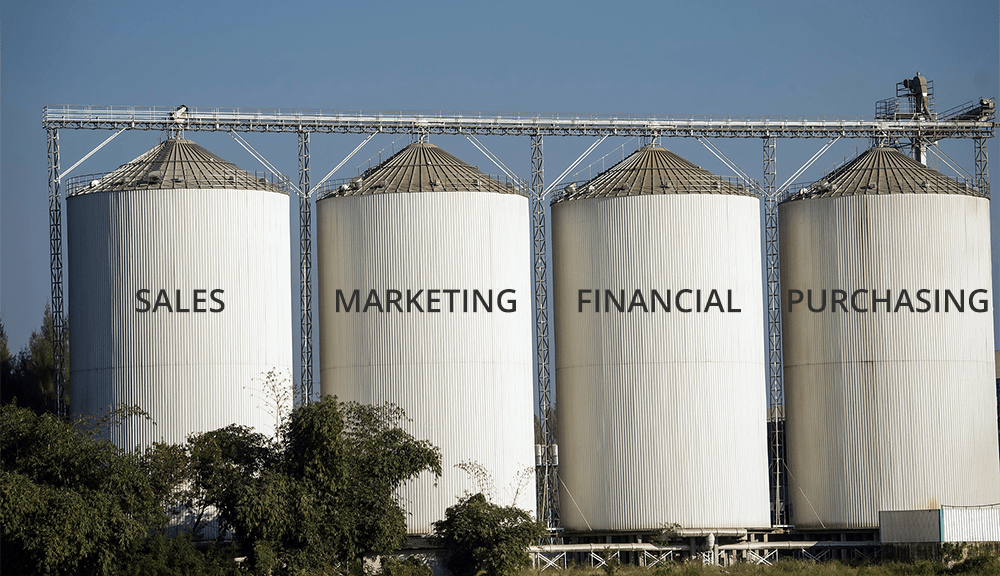
Having data spread across multiple non-communicating silos is one of the primary obstacles to digital transformation. It creates communication barriers between employees and prevents the creation of an environment conducive to the synergies, innovations, and improvements that could emerge between the different business functions of the company.
Integrating data into a single platform (often called a data lake) is necessary to enable the proliferation of data-driven practices and digital-based services. This is where Palantir Foundry steps in brilliantly.
To reduce data silos, Palantir developed Foundry. This platform allows you to:
Thus, these capabilities allow engineers, data scientists, and non-specialists to intuitively access the most relevant information to improve their business operations.
Airbus has been using Foundry since 2017. The platform allows it to collect, extract, and centralize all the heterogeneous data required for A350 production, including data from suppliers and data on the tablets of engineers and operators working on the A350. All assembly, operational, and safety data are consolidated in Foundry and presented in the form of customizable dashboards. This has helped better support the ramp-up of A350 production, as well as better anticipate and react to quality issues that could delay aircraft delivery.
Foundry allows Scuderia Ferrari to combine the technical expertise of the team's engineers with the immense amount of data at their disposal. Telemetry, spare parts, simulation, testing, and driver feedback data are integrated into Foundry. Instead of spending their valuable time integrating and cleaning this data, Ferrari engineers at the factory or at the track can focus on their most important tasks, using the data to make faster and better-informed decisions. Foundry has enabled the creation of a digital twin of the car, which engineers use to better analyze performance, adjust their hypotheses, and iterate quickly to converge on the best technical configuration to use for a given circuit.
Unlike Microsoft Azure, AWS, or Google Cloud Platform, which are very general-purpose cloud services, Palantir Foundry is data-centric: the platform is optimized for data ingestion, data engineering, data visualization, and machine learning.
Adopting and using Foundry is very simple. In your web browser, you will have all the tools pre-installed, pre-configured, and maintained by Palantir. An hour of training is enough for any operator to perform filters, aggregations, and simple charts to meet their use case. Foundry contains both code-based tools (code repositories & code workbook) for experts, and non-code-based tools (contour & data preparation) for non-technical beginners. This makes data manipulation accessible regardless of your level of technical expertise and gradually removes the psychological barriers often encountered when adopting data-driven practices.
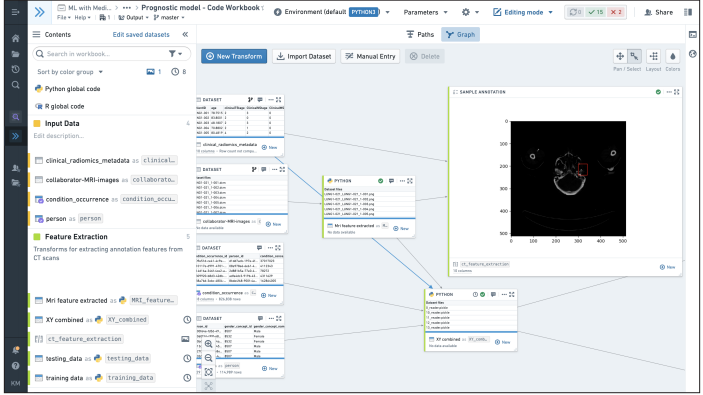
Foundry is designed to handle massive amounts of structured and unstructured data (including time series). It enables data ingestion, synchronization, and monitoring. Pipelines can be developed collaboratively (Git) using multiple programming languages (SQL, Python, or Java), and their updates can be scheduled. A data lineage feature allows the pipeline to be displayed on a user-friendly graphical interface (Monocle), which is highly valued by data engineers. Data analysts can create their data visualizations using code-based tools for more complex visualizations or no-code tools for standard ones (bar charts, histograms, pie charts, etc.). Data scientists will find the necessary tools to support them from machine learning prototype development through to production.
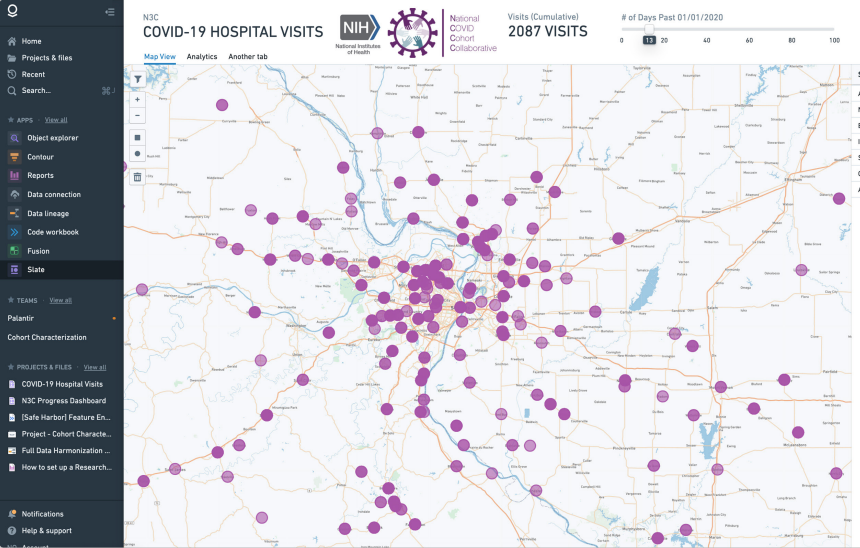
Thanks to its many strengths, the Foundry platform can become essential for a successful digital transformation. "We enable companies to regain control over the gold mines that are their data, and thus catch up with digital-native companies," asserts Fabrice Brégier, head of Palantir France and former CEO of Airbus.
We cannot overlook the success of Skywise, the Airbus Palantir Foundry, which has become a star in the aeronautics world in just a few years by integrating not only the manufacturer's data but also data from hundreds of airlines and suppliers; the ambition is to become the beating heart of aviation. That is, in fact, the Skywise slogan.
Aware of the importance Foundry will have for our clients in the coming years, Aqsone has developed expertise in this platform and intends to leverage it to bring more value to its clients during their transformation and data science projects. From ingestion to exploitation, including machine learning, we support our clients from their very first steps on Foundry and offer them use cases inspired by our experience.
Lorem ipsum dolor sit amet consectetur. Ipsum penatibus viverra feugiat amet varius pharetra porta risus lectus. Turpis enim massa non tincidunt in faucibus.